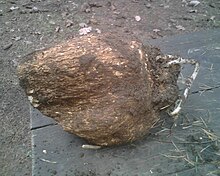
Wolfiporia extensa (Peck) Ginns (syn. Poria cocos F.A.Wolf) is a fungus in the family Polyporaceae. It is a wood-decay fungus but has a subterranean growth habit. It is notable in the development of a large, long-lasting underground sclerotium that resembles a small coconut. This sclerotium called "(Chinese) Tuckahoe" or fu-ling(茯苓, pīnyīn: fúlíng), is not the same as the true tuckahoe used as Indian bread by Native Americans, which is the arrow arum, Peltandra virginica, a flowering tuberous plant in the arum family. W. extensa is also used extensively as a medicinal mushroom in Chinese medicine.[2] Indications for use in the traditional Chinese medicine include promoting urination, to invigorate the spleen function (i.e., digestive function), and to calm the mind.[3]
Names
Common names include hoelen, poria, tuckahoe, China root, fu ling (茯苓, pīnyīn: fúlíng), and matsuhodo.
Botanical extract
Wolfiporia extensa is a source of a triterpenoid compound, pachymic acid, which has been the object of scientific study based upon the mushroom's role in traditional Chinese medicine. The species is often called cocos in this context.[4]
| This article uses material from the Wikipedia article Metasyntactic variable, which is released under the Creative Commons Attribution-ShareAlike 3.0 Unported License |