Grifola frondosa (also known as hen-of-the-woods, maitake (舞茸, "dancing mushroom") in Japanese, ram's head or sheep's head) is a polypore mushroom that grows at the base of trees, particularly oaks. It is typically found in late summer to early autumn. It is native to China, Europe, and North America.[2]


Description
Like the sulphur shelf mushroom, G. frondosa is a perennial fungus that often grows in the same place for a number of years in succession. It occurs most prolifically in the northeastern regions of the United States, but has been found as far west as Idaho.[citation needed]
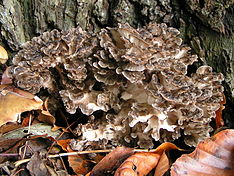
G. frondosa grows from an underground tuber-like structure known as a sclerotium, about the size of a potato. The fruiting body, occurring as large as 100 centimetres (40 inches), rarely 150 cm (60 in), is a cluster consisting of multiple grayish-brown caps which are often curled or spoon-shaped, with wavy margins and 2–10 cm (1–4 in) broad.[3] The undersurface of each cap bears about one to three pores per millimeter, with the tubes rarely deeper than 3 mm (1⁄8 in).[3] The milky-white stipe (stalk) has a branchy structure and becomes tough as the mushroom matures.[citation needed]
In Japan, the maitake can grow to more than 45 kilograms (100 pounds), earning this giant mushroom the title "king of mushrooms".[4]


Identification
There are no look a-likes that are toxic. This is a very distinct mushroom except for its cousin the black staining mushroom which is similar in taste but rubbery. Edible species which look similar to Grifola frondosa include Meripilus sumstinei (which stains black), Sparassis spathulata[5] and Laetiporus sulphureus, another edible bracket fungus that is commonly called chicken of the woods or "sulphur shelf".
Uses
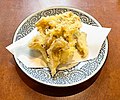
The species is a choice edible mushroom.[6] Maitake has been consumed for centuries in China and Japan[7] where it is one of the major culinary mushrooms.[citation needed] The mushroom is used in many Japanese dishes, such as nabemono.[citation needed] The softer caps must be thoroughly cooked.[3]
Research
Although under laboratory and preliminary clinical research for many years, particularly for the possible biological effects of its polysaccharides, there are no completed, high-quality clinical studies for Grifola frondosa as of 2019.[7][8]
| This article uses material from the Wikipedia article Metasyntactic variable, which is released under the Creative Commons Attribution-ShareAlike 3.0 Unported License |