Cordyceps /ˈkɔːrdɪsɛps/ is a genus of ascomycete fungi (sac fungi) that includes about 600 species. Most Cordyceps species are endoparasitoids, parasitic mainly on insects and other arthropods (they are thus entomopathogenic fungi); a few are parasitic on other fungi.[2] The generic name Cordyceps is derived from the Greek word κορδύλη kordýlē, meaning "club", and the Greek word κεφαλή cephali, meaning "head".[citation needed]

The genus has a worldwide distribution and most of the approximately 600 species[3] that have been described are from Asia (notably Nepal, China, Japan, Bhutan, Korea, Vietnam, and Thailand). Cordyceps species are particularly abundant and diverse in humid temperate and tropical forests.
Subtaxa
There are two recognized subgenera:[4]
- Cordyceps subgen. Cordyceps Fr. 1818[5]
- Cordyceps subgen. Cordylia Tul. & C. Tul. 1865[6]
Cordyceps subgen. Epichloe was at one time a subgenus, but is now regarded as a separate genus, Epichloë.[4]
C. sinensis was shown in 2007 by nuclear DNA sampling to be unrelated to most of the rest of the members of the genus; as a result it was renamed Ophiocordyceps sinensis and placed in a new family, the Ophiocordycipitaceae, as was "Cordyceps unilateralis".[7] Other species previously included in the genus Cordyceps have now been placed in the genus Tolypocladium.[citation needed]
Cordyceps and Metacordyceps spp. are now thought to be the teleomorphs of a number of anamorphic, entomopathogenic fungus "genera" such as: Beauveria (Cordyceps bassiana), Lecanicillium, Metarhizium and Nomuraea.[citation needed]
Biology
When a Cordyceps fungus attacks a host, the mycelium invades and eventually replaces the host tissue, while the elongated fruit body (ascocarp) may be cylindrical, branched, or of complex shape. The ascocarp bears many small, flask-shaped perithecia containing asci. These, in turn, contain thread-like ascospores, which usually break into fragments and are presumably infective.[citation needed]
Research

Polysaccharide components and cordycepin are under basic research and have been isolated from C. militaris.[8]
Sources and uses
Cordyceps are used in traditional Chinese medicine,[8][9] but there is currently no scientific evidence that their use has any clinical effect on human diseases.[8] Studies made on mice have found it to be an effective agent against fatigue.[10]
Fiction
The Cordyceps fungus is depicted as a core plot element in the video games The Last of Us (2013), The Last of Us: Left Behind (2014), and The Last of Us Part II (2020), in which a mutated form of the fungus infects humans and causes the collapse of civilization.[11]
In the novel The Girl with All the Gifts (2014) and its film adaptation (2016), a mutation of Ophiocordyceps unilateralis is responsible for an infection which also infects humans and causes the collapse of civilization.
Gallery
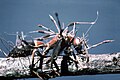
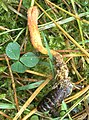
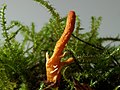

| This article uses material from the Wikipedia article Metasyntactic variable, which is released under the Creative Commons Attribution-ShareAlike 3.0 Unported License |